Microservices Architecture — How Systems Communicate
📌 What Problem Are We Solving?
- A monolith is one giant codebase — one process, one database, deployed as a single unit
- Works fine when small, but as the app grows:
- A bug in the payments module can crash the entire app
- Deploying a change to one feature requires redeploying everything
- Multiple teams can't work independently without constantly blocking each other
Microservices is the solution:
Split the system into small, independent services — each owning one responsibility, deployed separately, communicating over a network.
🗺️ The Big Picture
A typical microservices system looks like this:
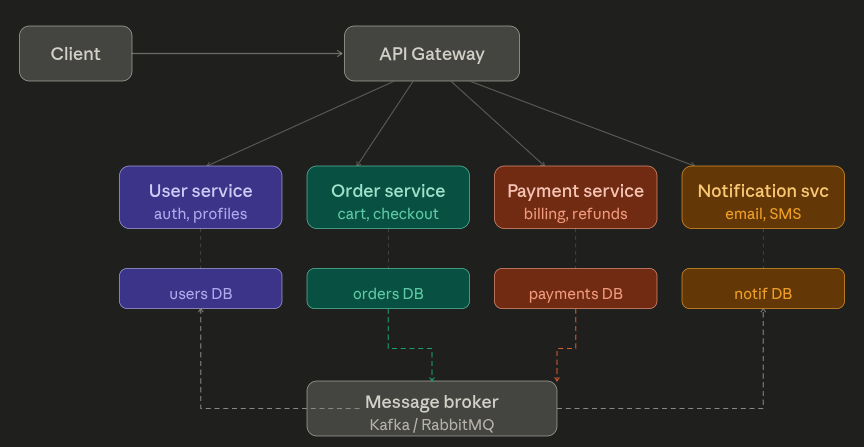
- Each box is a separate deployable service with its own database, codebase, and team
- Services talk to each other either directly (sync) or via a message broker (async)
- The API Gateway is the single entry point — it routes requests to the right service
⚡ The Two Fundamental Communication Styles
Every service-to-service call is either synchronous or asynchronous. Choosing between them is one of the most important architectural decisions you'll make.
1. Synchronous Communication
- Service A sends a request and blocks — it waits and does nothing until Service B responds
- Like a phone call — both parties must be available at the same time
// Order service calls User service
const user = await fetch('http://user-service/users/42');
const data = await user.json();
// Only continues AFTER the response arrives
✅ Good for:
- Queries needing an immediate answer
- Example: "Is this user verified?" — you must know before continuing
❌ Risk:
- If User service is down or slow, Order service is also affected
- Creates tight coupling and potential cascading failures
2. Asynchronous Communication
- Service A publishes an event to a message broker and immediately moves on
- Other services subscribe and react in their own time
- Like a text message — you send it and continue with your day
// Order service publishes an event — no waiting
await kafka.send({
  topic: 'order.placed',
  messages: [{ value: JSON.stringify({ orderId: '99', userId: '42' }) }]
});
// Immediately continues — done!
✅ Good for:
- Work that doesn't need an immediate reply
- Example: "Order placed → send email, update inventory, charge card" — all can happen independently
✅ Key benefit:
- If Notification service is down, events queue up and process when it recovers — no cascading failures
⚠️ Tradeoff:
- Harder to debug
- Order of events not guaranteed
- Eventually consistent, not immediately consistent
🔄 One Publish → Many Consumers (Fan-out)
A major async superpower — publish one event, multiple services react independently:
Order service  →  publishes "order.placed"  →  broker
                                                  ├── Notification svc  (sends confirmation email)
                                                  ├── Inventory svc     (reserves stock)
                                                  └── Payment svc       (initiates charge)
- Order service knows nothing about any of these consumers
- Add a new consumer (e.g. Analytics) without touching Order service at all
🧩 The 4 Communication Patterns You'll Actually Encounter
Pattern 1 — REST over HTTP [Sync]
- The most common pattern in microservices
- Services call each other just like they call any external API — HTTP verbs, JSON body, status codes
GET    /users/42
POST   /orders  { userId, items }
DELETE /sessions/abc
| ✅ Simple | Everyone knows HTTP |
| ✅ Easy to test | Works with curl / Postman |
| ❌ Slower | Not ideal for high-throughput internal calls |
| ❌ No schema enforcement | JSON can drift without you noticing |
Pattern 2 — gRPC [Sync]
- Google's protocol — you define a contract in a
.protofile, and code is auto-generated - Uses binary encoding over HTTP/2 — roughly 10x faster than REST for internal calls
// user.proto
service UserService {
  rpc GetUser(UserRequest) returns (UserResponse);
}
| ✅ Very fast | Binary + HTTP/2 |
| ✅ Schema = contract | Can't drift accidentally |
| ❌ More setup | Proto files to manage across services |
| ❌ Harder to debug | Binary format — can't just read it like JSON |
Best for: High-throughput internal service-to-service calls where performance matters.
Pattern 3 — Message Queue [Async]
- One producer, one consumer
- Like a task queue — jobs pile up and a worker processes them one at a time
- Tools: RabbitMQ, Amazon SQS
Producer  →  [queue]  →  1 Consumer

// Producer side
channel.sendToQueue('resize-image',
  Buffer.from(JSON.stringify({ url }))
);
| ✅ Decoupled | Producer doesn't wait for consumer |
| ✅ Durable | Messages survive restarts, retries built in |
| ❌ 1-to-1 only | Each message is processed by only one consumer |
Best for: Background jobs — image resizing, report generation, sending emails one at a time.
Pattern 4 — Pub / Sub (Event-Driven) [Async]
- One publisher, many subscribers
- The publisher doesn't know who is listening — complete loose coupling
- Tools: Apache Kafka, Amazon SNS
Publisher  →  "order.placed"  →  broker
                                    ├── Notification svc  ✅ subscribed
                                    ├── Inventory svc     ✅ subscribed
                                    └── Analytics svc     ✅ subscribed
| ✅ Zero coupling | Publisher is completely oblivious to consumers |
| ✅ Infinitely extensible | Add new consumers with zero code changes to the publisher |
| ❌ Eventual consistency | Data won't be in sync immediately everywhere |
| ❌ Harder to trace | A single action fans out across many services |
Best for: Anything where one event should trigger multiple independent reactions.
🧠 Quick Reference — When to Use What
| Pattern | Style | Use When |
|---|---|---|
| REST | Sync | You need an immediate answer. Simple internal calls. |
| gRPC | Sync | High-frequency internal calls where speed matters. |
| Message Queue | Async | One service does one background job per message. |
| Pub / Sub | Async | One event should trigger multiple independent services. |
⚠️ Key Gotchas to Remember
- Cascading failures — in sync communication, if one service is slow, the caller is slow too. Use timeouts and circuit breakers.
- Idempotency — async messages can be delivered more than once. Your consumer must handle duplicates safely.
- Event ordering — async brokers don't always guarantee order. Never assume a
payment.chargedarrives afterorder.placed. - Database per service — each service owns its own DB. Never share a database between two services — this recreates the tight coupling you were trying to escape.
- Observability — with many services, you need distributed tracing (e.g. Jaeger, OpenTelemetry) or debugging becomes a nightmare.